Translate

Showing posts with label #iteachk. Show all posts

Saturday, September 1, 2018

What Our Students Need: Switching from the Behaviorist to Cognitivist Model of Teaching. Part 2: Drop The Sticker Chart

If you are like most teachers out there your college coursework included 1 course, maybe 2 at the most, about educational psychology.

If you were like me, you might have felt you learned nothing about classroom behavior until the real world of teaching started (or if you took a spectrum of Special Education courses--life savers!).

Thrown to a hungry pack of wolves your first year you (speaking for a friend) likely tried everything in the book to get students to learn: pleading, cajoling, demanding, suggesting, and outright bribery. You don't have to explain it to me: Desperate times call for desperate measures.

One of the most espoused or showcased ways to "control" or change behavior is a sticker (or star) chart. A slip of paper with a grid of boxes will be taped to a desk, or laminated for a student, and that student earns stickers or stars for reaching goals during the day or week culminating, typically, in a reward.

Personally, I failed a lot, as most do, with sticker charts. Where's the stickers? Under the gigantic pile of papers? Misfiled in a drawer? Stevie needs one right now and I'm at a loss. Or, "hold on there Stevie, let me finish this lesson, followed by the counseling of 2 kids for fighting, followed by the snack, followed by Suzie having a emotional breakdown and I'll get you that sticker." I've even said, "Don't let me forget!"

Sticker charts are tools, and there might be that one instance, that one kiddo, that one time that it helps out (see my blog on Dandelions versus Orchids). But for the most part we are haphazardly attempting to use it and it won't help modify behavior when used inconsistently, or with an unrealistic goal (get 50 stars then you get to take a trip and see a special teacher). It's no wonder it fails.

Here are some typically classroom type charts:
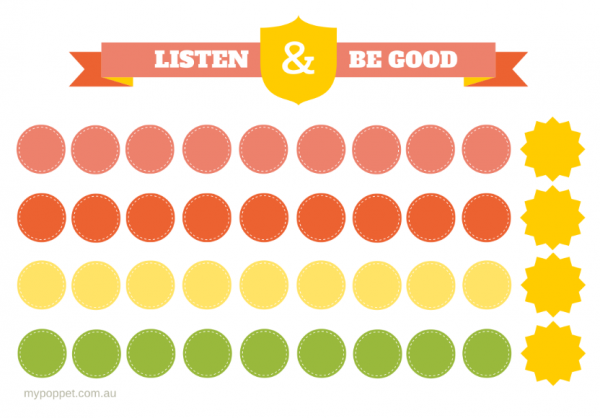
From a student viewpoint: What does, "Listen & Be Good" mean? This is too vague and takes too long to attain. I think I've been listening this whole time but I haven't gotten a sticker. I've already given up. I'll never "be good."

From a student viewpoint: This is pretty, but what is it for? I've already forgotten (visual clues would be best), and with 7 stars needed I might as well give up now. I'll forget what I'm supposed to do before I'm midway through. And 4 goals (large boxes on right)? I would do great to focus on 2 goals, 3 at most, before my brain forgets (Miller's Law).


From a student viewpoint: Why bother. I can't ever reach the goal. Now I'm losing points when I'm bad. I'm going to focus on the bad: it's staring me in the face. I won't care that I get a couple good points. I won't care that some year I might earn a trip to the office for a special visit. It will never happen. Don't you notice it already points out I will be bad?

Eeek! Do you see why so much can go wrong with what we think is a simple sticker chart?


When I do recommend sticker (or star, as in draw a star because I don't want to find a sticker) chart is for personal, short term use with a goal in mind. Here is a good example from Knoxville Moms Blog:
'
The target is clear, except for "good bedtime," what does that mean exactly? Taking a bath without a fight (I've been there!) if so, state that specifically. It only requires 3 times to be successful (short duration is key in the beginning). The kiddo can see their progress at attaining goals and then be rewarded: which can be as simple as time with mom playing a game of choice, doesn't have to be a Barbie Dream House. In situations like this, where follow through and discussion is likely (most families don't have 24 children) the chance of this helping encourage and mold expected behaviors  is great. It's focusing on the positive and the child can feel successful in a short amount of time. 

As a veteran kindergarten teacher I do recommend star charts to parents for at home use when there is a specific behavior is in need of modification and the parents are on board with follow through. But modeling the proper use, and explaining the "why" behind it,  is key. We need to remember that most folks haven't take psychology or neural education classes.

I hope I've showed you the good, the bad, and the ugly of sticker charts and encouraged you to save your money, your time, and your sanity by foregoing their use in the classroom.  Remember: Just because everyone one is doing it, doesn't mean it should be done, or that it's done right. Charts must be tied to easily understood goals, with clear expectations, frequent reinforcement, and follow through in order to be successful. Anything less is a waste of time. 


Thursday, October 5, 2017

The Power of Lights

It was late November as I started to hang up my Random Acts of Kindness (RAOK)  bags on clothespins in front of my classroom window. Each year we use these bags to not only count down until Winter break, but to bring attention to ways to be kind, through prompts and activities.  I explain to my students that during the holiday season we are all a little kinder, a little more considerate, and little more loving to one another.

 Afterward, I draped my string of Christmas lights along the wall surrounding our morning meeting area. The lights added to the festive nature, reminding me of good things in the world, like fairs, summer nights, and neon lights. I told my students that our lights reminded us to be kind to others; a symbol of goodness we should remember.

But soon the time was up. As the break approached and I prepared to take down my decorations I had a thought: why is kindness only once a year? Why take down my lights as if "kind time" is over and it's time to head back to the hustle and bustle, the pushing and shoving?

And so they stayed; through winter, spring, summer and fall. And the story of kindness no longer began in December with the hanging of lights, but in September with the reason why the lights are still hanging.

You see, lights are not just lights, they are symbols to which we attach constructs of our behavior. They are the meat, that prompts us to ring the bell, which in this case is the bell of kindness to all.

The next time you see lights in a classroom stop to reflect on their significance and ask the teacher why. Because it's not what it seems...it's not a light string with an expiration date, but a reminder of a year long practice cemented to our schema through visually cues and memories.


Saturday, April 22, 2017

Someone Was Going to, but No One Did: The Life of a Parent Group

I wasn't planning on going. Honestly, I didn't remember there was a meeting until I saw a familiar parental face setting up in the cafeteria as I finally left school at 5. I checked my email and sure enough there was a Lincoln Parent Council (LPC) meeting.

There is a parent group meeting tonight, I told Sierra. I tend to think aloud and really didn't expect a response. We should go, she said. We have to go home and let the dogs out, I said.

And so home we went. Sierra brought it up a couple more times in the car, but I was sure she would forget about it after we got home.

I have many good intentions that do not come to fruition. So many times  "I'd love to do that" becomes "I don't want to get back up off the couch." Teaching is tiring in a way non-teachers cannot even comprehend. I giggle each day as I see my student teacher say things like, "I can't even talk anymore" or "Why was I over here again?" I giggle and tell her she is indeed a real teacher now, not just a student teacher, and that her funny notations let me know I am normal, which is not always apparent to me.

Yet, as I sat, lethargically on the couch, at 5:25, Sierra showed up saying, Please Mommy, can we go? I promise to do my job while you are learning. You know learning is important. Who is this kid? And where did mine go? Okay, but you'll be with the child care group, I lamented.

As we approached the school I "ugh"d, as in UGH I forgot my phone! Not missing a step Sierra replied, That's okay, you won't get distracted while learning. Again, my chin fell to the floor in shock. Pod people? Alien invasion? Sierra maturing? Pod people seemed most likely.

Upon entering I was perplexed: there were 4 board members present and others. The others included me and our vice principal. So really, there were people present. 3 (even with free childcare).  Did you hear me say 3 parents to represent the 500+ students in our school????

Now, I'm not shaming anyone, as previously noted I have a hard time getting off the couch, however, there should be some folks, out of 500-1000 parents (depending on the 1-2 parent household ratio) that ARE available to attend at least once in a while. Ones that are younger, in better shape, and can get off the couch easier than I.

I'm seriously still in shock...and that takes a lot.

It reminds me of

“The Responsibility Poem”

There was a most important job that needed to be done,
And no reason not to do it, there was absolutely none.
But in vital matters such as this, the thing you have to ask
Is who exactly will it be who’ll carry out the task?
Anybody could have told you that Everybody knew
That this was something Somebody would surely have to do.
Nobody was unwilling; Anybody had the ability.
But Nobody believed that it was their responsibility.
It seemed to be a job that Anybody could have done,
If Anybody thought he was supposed to be the one.
But since Everybody recognized that Anybody could,
Everybody took for granted that Somebody would.
But Nobody told Anybody that we are aware of,
That he would be in charge of seeing it was taken care of.
And Nobody took it on himself to follow through,
And do what Everybody thought that Somebody would do.
When what Everybody needed so did not get done at all,
Everybody was complaining that Somebody dropped the ball.
Anybody then could see it was an awful crying shame,
And Everybody looked around for Somebody to blame.
Somebody should have done the job
And Everybody should have,
But in the end Nobody did
What Anybody could have.
Charles Osgood

Who is responsible for our children, our school, and therefore, our parent council? The village: we all have a part. Whether you are able to show up, or just volunteer for an at home job (like coordinating an event) step up. Our village desperately needs you...